New London Architecture
Five minutes with... Ben Glover
Tuesday 25 April 2023
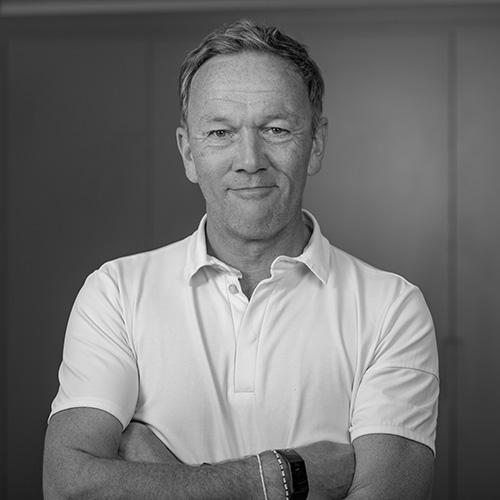

David Taylor meets Ben Glover of Arup to discuss his work on the Brent Cross substation alongside IF_DO and artist Lakwena, and how projects like this and Arup’s toolkit help progress the circular economy.
David Taylor
David Taylor
Hi, Ben. How are you doing?
Ben Glover
Hi David. Great, thank you. Nice to meet you!
David Taylor
And you! I wanted to talk to you about your work, chiefly on the circular economy, but also in terms of an actual physical project, the Brent Cross substation, and how those things might interface? Would you be able to tell me about your work there? How did you get involved?
Ben Glover
Yeah, absolutely, I think maybe a bit about my background would help here?
David Taylor
Great!
Ben Glover
I've been working with Arup for over 20 years and a lot of my background is in industrial engineering. So: heavily serviced, technical buildings is kind of where I became really interested in coordinating multidisciplinary design and the purpose of the overall projects that we're delivering. I guess I got involved in waste-to-energy type work about 15 years ago, as lead infrastructure and building designer. And that was fascinating enough, but the interaction with the process that was going on inside the building – the machine parts of the conversion process, taking that black bag rubbish and turning it into power – that really hooked me into thinking about our precious resources. And you know, how we need to treat them with the care that they deserve. And I'm now working on circular economy projects, waste-to-fuel net zero transition plans, that kind of stuff. I'm based in London, but my work rarely affords me the luxury of working on projects in London, except for the project you mentioned earlier, the Brent Cross Town substation.
David Taylor
And why is that primarily the case? Is that because of land values, and the perceived need to have these sorts of facilities outside of major urban centres?
Ben Glover
Yeah, absolutely. The kind of nationwide network of facilities, the amount of waste we collect together in certain areas warrants a certain amount of these waste-to-energy facilities. And so generally, the projects we get involved in are across the UK and very rarely just in and around London.
David Taylor
Tell me about Brent Cross. I mean, obviously, it's a very different kind of scheme in terms of its aesthetics. Is that part of its success, do you think? That it doesn't look like a waste centre 'should' look like?
Ben Glover
Yes, so the Brent Cross Town job is a primary substation, and its purpose is to distribute that power to the upcoming development at Brent Cross. From that point of view, there's an energy centre next door and green energy will be provided through that project into the substation, which will then be distributed around the Brent Cross Town site. And it is a very different project, like you say. You wouldn't look at it and think it was a primary substation. And the purpose of that from the developer's point of view is it needs to be a beacon to the site. It's the first thing that's been built. It really demonstrates what's going to happen and the great things that are coming to this area of London.
David Taylor
And how did you work with Lakwena, the artist involved there?
Ben Glover
We had a long relationship with Related Argent. I mean, Arup's relationship goes back about 30 years. What that affords us is the ability to put forward innovation. They really trust us to make decisions, and we bring them along with us as we as we go. And so, as I said, this development was really about a beacon. If you think about the triple bottom line in sustainability, from an economical point of view, clearly, it's a beacon to the site, and people will see this on the train line, they will see it on the North London circular, and about six million people a year will see this project. The idea is that they think: “ooh that's great. What's that all about?” And they look it up. And they see there's a development and they think about having their office there or living there and being able to commute from there. So that's the economic side of it. I think you asked about the artist – there was a competition to select a new architecture firm. And in this particular case, IF_DO were the architects that won the project, and they agreed to collaborate with Lakwena, a local artist. To me, when I saw the winning entry, it really ticked the social box for the triple bottom line. It really did bring alive the area and give a nod to the existing communities that live in Brent Cross Town and the communities who will come to Brent Cross Town.
David Taylor
Do you think it will influence this typology in the future? Do you think providers of such substations will now think that they should be a bit more adventurous in terms of the designs of the buildings that they create?
Ben Glover
Yeah – actually, if you look there are some really nice examples of substations. But mostly they're hidden away. You know, people try to hide them. It's not an area of interest. So I think people will start thinking about that. It became a real opportunity to convert a site that was derelict brownfield; disused, unloved, and we've rewilded that site and made it a part of the local community. I think there's a number of other really good benefits that have come from this project as well. For example, it's open to the elements. It's not hidden away in a building, so it naturally ventilates itself. And that reduces energy consumption. And, as I've mentioned, the first two elements of the triple bottom line, the third part, the environmental part, for me that bit was missing. And I really felt that this project needed a drive to make it more a project for the planet, as well as the people and place.
David Taylor
The other substation that springs to mind that was aesthetically progressive that I can think of was at the Olympic site. The scheme done by Nord Architecture, which was, you know, for 2012. So, I suppose this is an area that that could be on the rise in terms of being a bit more aesthetic about such projects.
Ben Glover
Yeah, I think I might have walked past that one recently! Yeah, it was a beautiful site. Another one I'm thinking of is on the South Bank by the museum there.
David Taylor
Yeah.
Ben Glover
And potentially, you know, if this is about new developments, of course, the primary substation is going to be one of the first things that are built. And so that ability to be a beacon for the site to give people a glimpse of things to come, I think is a really useful thing for a developer to think about.
David Taylor
Now, the other thing I wanted to talk to you about is the Circular Buildings Toolkit, which I think is about a year old now. I think you launched it, in March last year, along with the Ellen MacArthur Foundation. Could you tell me a little bit about the toolkit? What essentially, does it offer?
Ben Glover
Yeah, the framework that we've developed here with Ellen MacArthur Foundation, first of all, the most important thing to say is it's free to use for everybody. So, the toolkit is there. If you search for circular buildings toolkit, you'll find it very quickly. I think the toolkit is really useful for all kinds of designers. It points towards different interactions you can have with a designer at different stages, that can just make us think about circularity, and how we can innovate to achieve that circularity. The tool's broken down into a series of different kinds of instructions to the designer.
So, the first point is to build nothing; to refuse new construction. But then it moves on quite quickly to build more long-term value, build efficiently and build with the right materials. And within all of those, there's a framework of different decisions and strategies, actions and things that you can take to really think about where those materials might come from, or how we might disassemble the project at the end and reuse those materials in future projects.
David Taylor
And lastly, how would you say we are performing, as a nation and perhaps as a city, London, in terms of the circular economy? What sort of marks would you give it out of 10, for example?
Ben Glover
We're struggling. Really struggling. But the amount of discussion around circularity at the moment is really encouraging, and the amount of different people trying to incorporate circular design even you know, one step at a time. At Brent Cross we have reused steel work, which I think is a really useful first step towards changing the steelwork industry. But across the nation, very recently, there's been a report released by Circle Economy and Deloitte (https://www.circularity-gap.world/united-kingdom) about the circularity of the UK and, from memory, it says we are 7.5%, circular. So, a long way to go. But then that fascinating report then talks about, you know, we have lots of materials held up in storage. They're in buildings at the moment, they're already extracted from the earth, and they are there for future generations to use. New projects we build now will put materials into storage. And so we really do need to think about how those materials can be disassembled at the end of the project and reused; kept to their highest value. And I guess coming back to the framework, it constantly reminds us to think about the materials, keep them at their highest possible value, and keep them in circulation for future generations.
David Taylor
Well, thank you very much, Ben. That was a fascinating insight into both Brent Cross and circularity in general. Let's hope we can get up to eight, nine 10%, circular inside a decade. Are you optimistic about that?
Ben Glover
Absolutely. You know, we're already taking the challenge and starting to disrupt the design process. So yes, we're up for the challenge. And we can do it as an industry.
David Taylor
And with delight with projects like Brent Cross, as an important consideration.
Ben Glover
Absolutely. Bringing the joy to what we do, and to the society around is super important.
David Taylor
Excellent. Thanks a lot, Ben.
Ben Glover
Thank you, David.

Image: John Sturrock
Share this news


Recent

News
Five minutes with... Nic Durston
David sat down with Nic Durston at UKREiiF to talk about the sentiment at this year’s Leeds show, and how culture and co...

News
Rethinking Tall: From output to input in London’s next generation of towers
Following NLA’s London Tall Buildings Survey, Callum Tuckett, Managing Director at Multiplex, explores how digital innov...

News
From Retrofit to Futurefit: Reframing reuse for a resilient urban future
Ahead of the Built World Summit, Harry Cliffe-Roberts of Gensler explores why ‘Futurefit’ reuse must become central to c...
Stay in touch
Upgrade your plan
Choose the right membership for your business
Billing type:
Small Business Membership
£90.00
/month
£995.00
/year

For businesses with 1-20 employees.
Medium Business Membership
£330.00
/month
£3,850.00
/year

For businesses with 21-100 employees.

View options for
Personal membership