New London Architecture
Five Minutes With... Brian Connolly
Tuesday 25 February 2025
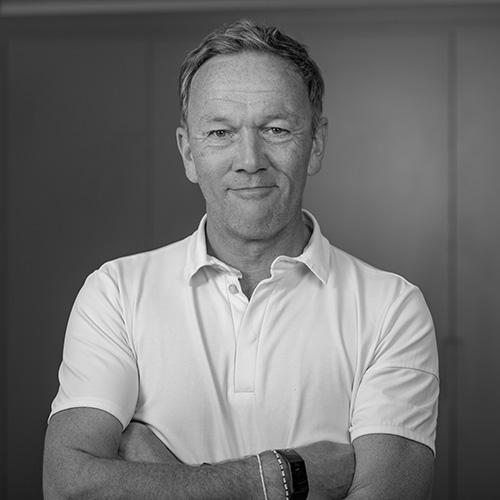

David Taylor meets HOK’s regional leader of science and technology in London Brian Connolly to talk through the rapidly evolving trends affecting laboratory design in the capital and further afield.
David Taylor
Hello, Brian, how are you?
Brian Connolly
I'm very well. Thank you for taking the time.
David Taylor
Congratulations on your promotion to regional leader of science and technology for HOK in London. I wanted to ask you, firstly, a really broad question given your 20 year-long expertise in this particular sector: how would you say lab design is changing in London and across the world?
Brian Connolly
Well, firstly, I'd like to say thank you for giving me the time. A little intro: I'm really excited about moving into this role. I'm leading an incredible group of people in HOK in London; they're really super-experienced and have great passion, and I think we're going to be able to drive forward lab design for a lot of our clients into the future.
So, the question: how has lab design changed? I think the science industry itself is evolving incredibly quickly over recent years, and that’s because it's at the forefront of both the media and people's minds since the pandemic. I think there's quite a lot of shifting in science, and how science functions generally. There's a lot of cross fertilization of ideas, with multi-disciplinary science going on together in the same spaces. The type of equipment and spaces that scientists need has evolved rapidly, and a lot of that is around new technologies, particularly automation, the use of large language models and AI, which is moving forward at a pace.
People's expectations about what a lab environment should be is also quite key. Gone are the days of scientists living in basements. Younger scientists are used to coming out of very nice institutions and expect to work in pleasant places that are safe, and where they can meet and enjoy working with their fellow colleagues. We're doing a lot of work around neuro-inclusivity, as well. So, all those aspects are converging together to really bring forward much more functional and efficient laboratory spaces, but also spaces which need to be operationally flexible and adaptable. Of course, there's a big focus on cost, and aspects around how you deliver lab spaces, particularly in the construction environment – we're looking at a lot more use of modern methods of construction, particularly off-site manufacture, which derisks the construction process, but also the programme and the cost. It allows people to have much more assurity on what they want to get delivered as an end result. I think for a lot of our clients, particularly our commercial clients, they need that, moving forward, as there's a lot of requirements for volumes of lab space. So it's making sure that they deliver the right type of lab space, rather than just a standard spec. We're starting to understand that just delivering a one size fits all lab isn't necessarily the right way forward.
David Taylor
I hear a lot about the need to design spaces for chance encounters and serendipitous meetings between people to sort of forge ideas, certainly in the education sector. Is that the same issue for lab space?
Brian Connolly
It's exactly the same issue. I think what we need to understand is that a lot of the work scientists do isn't done in isolation. They meet their colleagues; they talk about what their colleagues are doing. Sometimes their colleagues are doing something in a completely different space. And actually, as they combine the types of work together, it becomes more than just the sum of its parts. So, scientists need to be able to move around. They need to be able to interact outside the lab environment, and a lot of that can be just chance encounters. It can be the ‘over the water cooler’, or in the coffee shop. So, a lot of the buildings we're delivering now are laboratory buildings, but actually they really do have quite an incredible offering of different types of spaces, whether that be staff welfare spaces, general spaces for them to go away to and have quiet time and focus times, and also spaces that flex around to suit the needs of the staff throughout different times of the day, whether they want to meet in large groups or in little huddle areas. So, lots of different types of spaces outside the general lab. We're also looking at actually what they can do within the lab. Labs are very controlled environments, and they can be quite stressful for people working in there, so we're looking at how we can start to ease that as well. And, as I said, looking at neuro inclusivity design, not just in the work in the office workplace, but bringing that into the lab. Sometimes it's just visually and sometimes it's just creating different types of zones, whether they're for different people who have definitely identified different types of neurodiversity across the spectrum.
David Taylor
Now, you've delivered the Crick Institute, obviously, and you've got a couple of other upcoming projects; one in Glasgow and one in Cambridge, Merlin Place. Do you want to talk briefly about those projects?
Brian Connolly
Yes, we have some very exciting new projects coming, either on the drawing board or currently under construction. Our project, Merlin Place, is in the north of Cambridge. It's adjacent to the Kent Science Park and the St John's Innovation Park, just a short walk from Cambridge North Station, and this building is really designed as a hub for Life Sciences. It's got a range of social places for people to interact, it's got cafes on the upper floors, then social spaces embedded within the offices and the labs, and a roof terrace looking out over Cambridge. I think it's a large volume of laboratory which has been very well fitted into what is a constrained site. And the excitement of it is that it's got a very good target for sustainability. We're hoping for the entire life cycle, to use the UK net zero carbon building standards as a basis of the approach, and again, we're aiming for targeting BREEAM Excellent. So that's 139,000 square feet over six storeys of commercial office. And then in Glasgow, another exciting project that we're working through is the Keystone Building for the university. This is again a hub for students of all disciplines in the mix. So, we've got general teaching labs, we've got research labs, and again, it's got collaborative areas and cafes, and we see this being targeted for completion in the 2028/2029 academic year. It extends across, I think, 27,000 square meters, accommodating up to 3,600 students. So, this is very exciting as well. This hopefully will be the largest net zero carbon university building in the UK, when it comes on.
David Taylor
Wow!
Brian Connolly
And also, we're also including neuro inclusive workspaces embedded throughout that as well. So yeah, two very exciting projects - we have lots of other ones. We're also looking at ecosystems across some of our commercial and university clients. So, we do ecosystem studies, and really this is what I call unlocking the Gordian knot that either academic or commercial institutions get themselves into, trying to unlock the legacy infrastructure, understanding their evolving research needs and the general spatial inefficiency that they've made or grown over a period of time. We have our ecosystem process where we do completely data driven mapping, which brings out a kind of holistic approach to analysing how spaces are used, how they interact with their surroundings, and how to optimize themselves for future growth. A lot of this is around unlocking business cases, so they can put forward the justification for funding to go in and help them to rationalize and uplift their general spaces, for both academic and commercial clients. It really helps in staff retention and also attraction, bringing people to go and work for them, or to go and study there.
David Taylor
Final question – could London be a leader in this area, if it isn't already, and where else in the world is it up against? Where is it competing with?
Brian Connolly
London is a leader, I believe. It's moving rapidly. We do have competition, obviously from places like Boston. You've got California, so I think there's always going to be challenges, but I think we accept that with relish. I think when we look at some of the new, what we call clusters, or a hot spot, we see new areas growing up. You have places like Canary Wharf and Canada Water. You've got White City. You've got lots of different scales as well, which I think is much more interesting. You don't want necessarily one size fits all for these hubs; you want to attract different types of science, different types of innovation. And that kind of spreads out across the country to some of the kind of powerhouses of the north, and we've got things like in Scotland the innovation corridor. But I think for London in particular, the advantage, obviously, is the connectivity that we have here. We've got a lot of institutions and trusts that are already in areas around London that people can build around. There is Whitechapel, where you've got Queen Mary. You've got Sutton, for example, where you've got the Cancer Hub. You've got the financial technology and digital health area at Canada Water, which is interesting, how that has evolved moving with the financial hub, but bringing in the life sciences, which is at fast pace down there. So, a lot of new buildings going up. And then you've got the Knowledge Quarter, which is evolving still. The Crick went into that area quite a long time ago. You've still got buildings which are coming up on the opposite side of Kings Cross. They're bringing forward a lot there. So, I think there's different types of spaces being used, and I think developers and institutions are becoming much savvier around what spaces they're delivering.
So, it's not just, as I said previously, a standard spec. I think people need to be a bit cleverer around what type of science they want to bring into their cluster or their hub, particularly in London. So, I think the offering is great. We're working with clients to make sure we what we call future ready, some of these spaces, because investing in science facilities does require a premium to a certain extent, so we have to make sure that they're going to be attractive and functional when they come on, when they come to market. We also have to look at speed to market – that is quite key, because a lot of the science spaces are needed now, so we have to move them forward quickly, but we have to make sure that what we deliver is going to be fit for purpose going forward into the future.
David Taylor
Well, congratulations on your promotion again, and good luck in adding to this important and sector for the capital.
Brian Connolly
Yes, thank you, David. And we'd love if you could come into our office, and we can wow you with some images - and we have very nice coffee.
David Taylor
Oh, excellent. Well, that's a fantastic lure for chance encounters and idea exchange! So, yeah, fantastic, will do!
Brian Connolly
Okay, thank you!


Share this news


Recent

News
Five minutes with… Leigh Johnson
David Taylor meets Leigh Johnson, managing director of Barking Riverside, to quiz her over the 20,000 homes project and...

News
Winning Design Announced for 'Hope in the Square' Competition
NLA in partnership with the London Borough of Southwark are proud to unveil the winning design of our 'Hope in the Squar...

News
Our partnership with ActionFunder to deliver measurable social value
NLA and ActionFunder partner to give London’s built environment sector a scalable way to deliver and prove community imp...
Stay in touch
Upgrade your plan
Choose the right membership for your business
Billing type:
Small Business Membership
£90.00
/month
£995.00
/year

For businesses with 1-20 employees.
Medium Business Membership
£330.00
/month
£3,850.00
/year

For businesses with 21-100 employees.

View options for
Personal membership