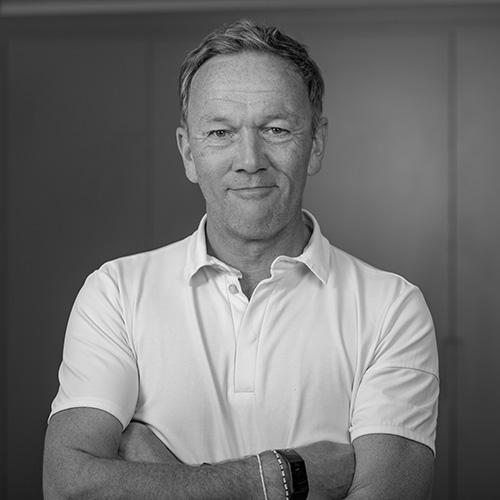
David Taylor
It's security, principally, is it? Financial, and otherwise?
Chris Williamson
Um...well, we're expected to be profitable! They're interested in us because we run ourselves quite professionally. And I think that's one of the things that we've always liked to do as architects. Sir Norman Foster said when I was at university, that there's no reason why business and art shouldn't mix. And the idea of an artist starving in his garret, you know, shouldn't be the way that artists and architect's work. So that's something we've always tried to do. We've always tried to run efficiently and be professional. And that's what architects get criticized about in the main, in all the client surveys at the RIBA - that architects are fantastic designers, but they're not great businessmen. That ties in with our sort of philosophy. But yeah, it became apparent that it would be a much closer union than it originally probably started out as talking about collaboration. So, the decision was taken. Not just for us old guys, the partners, but for the opportunities that it created for all our staff; the key emerging designers, the young talents, the rising stars. It will give them fantastic opportunities, which have already started to come through in various places, with putting bids together. We invest in our talent, and it gives them greater opportunities to do more exciting projects in different parts of the world. But the other major reason why they were really good to work with is that they were very clear that we kept our brand, we kept our way of working; we were keeping our culture. So, all of the things that we'd written in our 20-year vision. Because the vision wasn't just about the kind of work we want to do. It was about where we wanted to be in 20 years' time....
David Taylor
...and where is that, just briefly, in a nutshell?
Chris Williamson
So just to skip that, just for a second, it was about the way we treated our staff and worked with people and our collaborative culture. It's very important to us that that doesn't change. And we're not [just] part of a large engineering group. And we can still retain our collaboration with our existing consultants...we've been working with some engineers for over 30 years now. It's important to us that we were able to do that and keep our relationships. So, some things in the UK and our current markets won't change. And it's business as usual, in terms of the kind of work we do and the collaborations we have. But in some markets, it gives us greater opportunities to forge new relationships. And sometimes it will be working with Egis. Sometimes it will be working with our existing consultants – the kind of work that we do is based on whoever is best for that particular project, who's got the best CV, who's the most experienced for that kind of work.
But going back to your question of where we want to be. It is driven more by the kind of work that we want to do. We've really enjoyed working on projects like Crossrail and Melbourne Metro, these city-shaping projects, and more and more cities around the world are doing those projects. And they all have fantastic transport-related developments attached to them. We've started to do more of that in the UK and elsewhere, where we're looking at the transport opportunities, but also how it shapes the city. We've now got a great masterplanning department. We've always done social housing, and affordable housing. And we've now started to tag on to that the mixed use and residential. So, trying to piece together these new parts of cities, which are emerging in London, on the back of Crossrail, the Northern Line extension and the Bakerloo Line Extension when it happens. And those city-shaping projects are emerging in different parts of the world. So, we enjoy those and the opportunities that it brings, and this will allow us to do more of it. We want to continue to grow but not for growth itself, but just to work on those exciting projects.
David Taylor
So: last question, in two parts. Firstly, what was it about the fit with Egis that contrasted with the fit that you thought didn't work with your other people that approached you? And secondly, how sort of cloak and dagger did you have to be about keeping all this schtum for quite a long period of time, I imagine?
Chris Williamson
Because of the nature of these negotiations, as a set of partners, we had to sign a non-disclosure agreement for a while because there are important financial considerations on both parties. But we shared it with the staff as soon as we were able to do so. And, when they found out and met the people at Egis, everybody has been really supportive and can see that it's a great fit. Then we spoke to the consultants that we work with and all our colleagues in the industry; we obviously haven't managed to speak to everybody. But the people that we spoke to were really supportive and said: “Yep, I can see why you've done this. And it looks great”. It's been very positive, the reaction.
David Taylor
And then the first part of that question, what about the fit? Why was this fit so good, where the other one – or ones – weren't?
Chris Williamson
It was really about the people and the culture. We visited their office, we met their sustainability teams, we saw their value and what they want. They wrote the 2050 Plan for Paris…
David Taylor
…Yeah, amazing.
Chris Williamson
They have a fantastic technical team that we will be able to slot into our team on projects on a best-for-project basis. So it was really about the people, and the culture and the fact that they were saying to us, "we like you as a company, we're going to let you continue as you are. We're here to help". But, you know, obviously, if we don't perform, they'll help us make sure we do. We're very positive about it. We know we can be successful. We've worked in lots of different places around the world in the past, and I’m sure we will in the future, and be successful at it. So, it was really about the cultural fit. I mean, I can't really say much about the people that approached us, but they were mainly engineering firms in the same sort of sector that we work in, and I mean, it hasn't happened that often. But it has happened in the past and it hasn't really got very far. We've just said, "well actually, we're doing okay”. We didn't like the way their offices looked, or the way conducted themselves, but in this in this situation, Egis have been really pleasant. Really nice to do to do business with.
David Taylor
Are all your meetings in French? I hope your French is up to it, Chris!
Chris Williamson
No, that's something I've got to work on. (laughs) I used to love French at school but to be honest...when I was the International President to the RIBA, I was on the Architects Council of Europe, and I joined the French Anglo Architects Liaison Group. But no, that is something I've got to work on and that's something we all get teased about because obviously, everybody, well, most of them speaks English. Yeah. Not many of us speak as good French…
David Taylor
Well, Duolingo is a good app I can recommend!
Chris Williamson
Yeah! Yeah.
David Taylor
Well, congratulations, Chris. We're well over five minutes, but it's been fascinating hearing about the next phase of the firm. Really, that's how it must feel to you as a founder; that it's the sort of new era for the firm, is it?
Chris Williamson
It is. It has certainly given me a new lease of life. I'm really excited about the next 20 years! Norman Foster's in his mid 80s. That's what I'm looking forward to.
David Taylor
Excellent.
Chris Williamson
And I think, yeah, this is a really exciting new chapter.
David Taylor
Brilliant. Congratulations again, and thanks for sparing me some time.
Chris Williamson
Thank you. Thanks. Bye